Strengthening Interdisciplinary Teaching: Faculty Development Program 2025 at United College
Feb 1st, 2026
Category - Blogs
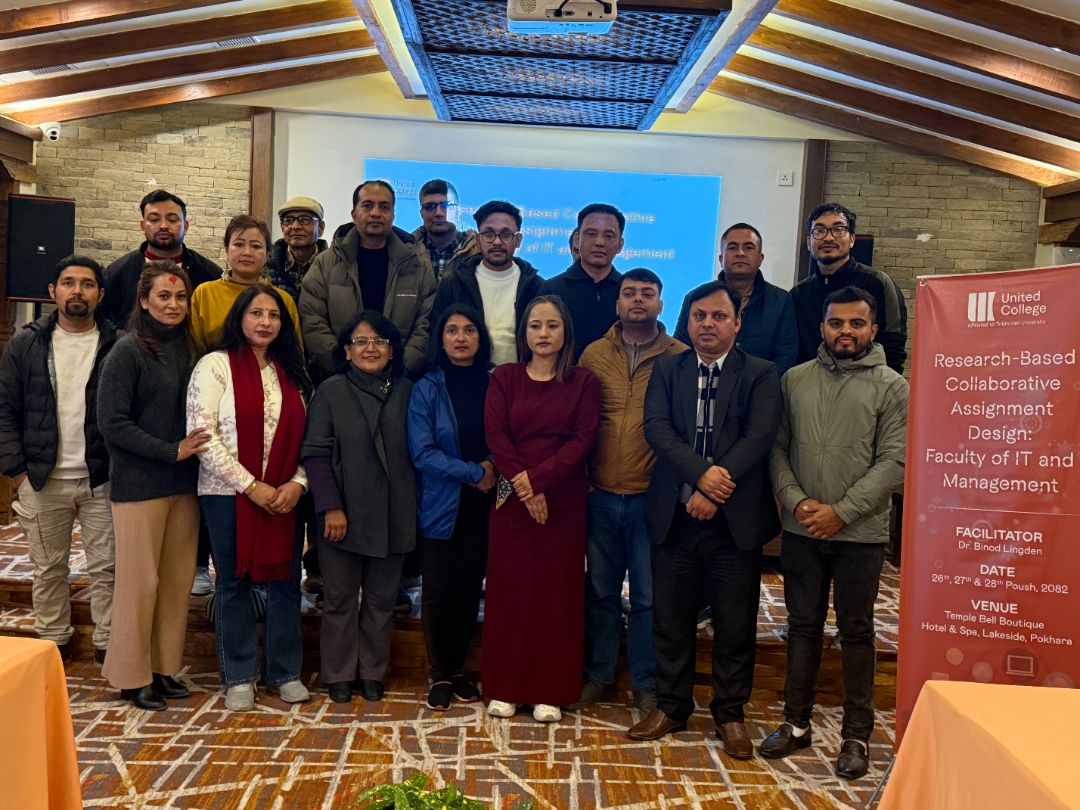
United College continues its commitment to academic excellence and innovative teaching practices through meaningful faculty development initiatives. In this spirit, the Research Management Cell (RMC) successfully organized a three-day Faculty Development Program (FDP) titled “Training on Research-Based Collaborative Assignment Design: Faculty of IT and Management.” The training was held from 26th to 28th Poush 2082 at the serene Temple Bell Boutique Hotel & Spa, Lakeside, Pokhara.
Why This Training Matters
Higher education today demands more than subject-specific knowledge. Students must develop critical thinking, research capability, problem-solving skills, and the ability to collaborate across disciplines. Recognizing this need, United College designed this program to help faculty create research-based collaborative assignments that bridge the gap between Information Technology and Management education.The goal was clear: prepare faculty members to design assignments that mirror real workplace situations—where technical and managerial knowledge come together to solve complex problems.
Expert Guidance and Active Participation
The training was facilitated by Dr. Binod Lingden, Research Coordinator, who guided participants through interdisciplinary teaching strategies, assignment design, and research integration techniques. A total of 22 teaching and non-teaching staff members took part in the program, bringing diverse experience and enthusiasm to the sessions.Participants engaged in interactive lectures, group discussions, case studies, peer reviews, and hands-on exercises—ensuring that learning was both practical and collaborative.
What Happened During the Three Days?
Each day focused on a structured progression:Day 1: Understanding research-based collaborative assignments and identifying interdisciplinary themes
Day 2: Designing structured assignments and integrating research methodologies
Day 3: Peer review, refining evaluation rubrics, and planning classroom implementation strategies
By the end of the program, faculty members had drafted and finalized interdisciplinary assignments aligned with research standards and fair assessment practices.
Key Outcomes of the Program
The FDP achieved impactful results:- Faculty gained practical skills to design research-oriented collaborative assignments
- Stronger collaboration developed between the IT and Management departments
- Participants learned to integrate research methodologies, statistical analysis, and evaluation rubrics
- Assignments were designed to simulate real-world problem-solving scenarios
- Faculty reported increased confidence in implementing interdisciplinary projects in BCA, BBM, BBS, and MBS programs
From Training to Classroom Practice
During the training, two faculty members, each representing a different subject from two programs, developed a collaborative assignment question. Detailed guidelines and instructions for conducting the assignment were prepared, integrating Business Research Methods for BBS Fourth Year and Business Statistics for BBM Third Semester. Faculty members of the other subjects also developed their collaborative assignment questions partially during the training and completed them afterward at the college.Feedback and Way Forward
The program was evaluated as highly effective. Faculty appreciated the relevance, clarity, and practical nature of the sessions. Recommendations for future trainings included longer hands-on sessions, more sample case studies, and follow-up mentoring to support classroom implementation.Conclusion
The Faculty Development Program 2025 successfully laid a foundation for research-oriented, interdisciplinary teaching practices at United College. By empowering faculty with the skills to design collaborative, research-based assignments, the initiative ensures that students are better prepared for academic challenges and professional realities.This FDP marks another step in United College’s journey toward innovative education, a stronger research culture, and enhanced academic quality.